
Ultra-simplified guide: How to scale on Meta in 2026.
By Lachezar Voynov
Share this article

Here’s an ultra-simplified guide on how to succeed with Meta Ads in 2026 and create a successful DTC Ad Creative Funnel.
Most eCommerce brands doing $2M to $50M in annual revenue hit the same creative wall.
Their primary customer avatars are exhausted, CPA keeps climbing, and the ad formats they used to scale 6 months ago are no longer effective.
They have an agency or an in-house team that keeps delivering more content, but volume isn't solving the problem.
The real issue is not the amount of content you’re creating.
It's that you're fighting over the smallest, most expensive slice of the market while 80% of your potential customers never see your ads.
Keep in mind that these are observations based on our clients' deployment of over $20M in Meta ad spend, which generated $50M in sales and delivered 2 billion impressions in 2025.

At that scale of spend and impressions, you see patterns that brands spending $100k, $500k or $1M per month simply cannot see.
We see what works across many different industries.
We also see what doesn’t work and the differences between brands spending $50k/mo and brands spending $2M/mo.
The first thing you need to understand is why your current approach has a built-in ceiling.
When you're overseeing over $20 million in ad spend and close to 2 billion impressions, you get a real-time view of how Meta's algorithm actually works.
Meta, with all its latest updates - Andromeda, GEM, Lattice doesn't just need "more content."
It needs creative diversity to function.
While our clients have spent just over $20M, I’ve seen at least $20M more in ad accounts I’ve personally audited this year and 90% of eComm brands still get it wrong.
They think creative diversity means 50 UGC creators saying the same thing.
Different faces. Different hooks. Same angle. Same boring UGC format.
At the end of the day these are just iterations of the same thing so hitting a revenue ceiling is not a surprise.
You've exhausted your primary customer avatar.
There's a ceiling on how many 35-year-old wellness-obsessed moms you can reach profitably.
To scale further, you need to unlock new market segments.
Meanwhile, Meta's algorithm is trying to serve "the most relevant ad to the most relevant person."
But if all your ads are targeting the same persona with the same angle in the same format...
The algorithm has nowhere to go and it just keeps serving the same people at higher and higher costs.
The brands that scale past $1M per month aren't making more of the same content.
They're systematically unlocking new audience segments by deploying true creative diversity -different personas, different angles, different formats, mapped to different stages of awareness.
Everything starts with understanding the Larger Market Formula.
Here’s what’s happening in your market:
-
3% are ready to buy RIGHT NOW
-
17% are actively shopping and comparing options
-
20% know they have a problem, but have no idea what solutions exist
-
60% don't even know they have a problem at all
This is called the Larger Market Formula.
Most eComm brands are fighting for that 3% to 20%, which is the most competitive and most expensive slice.
Eugene Schwartz identified 5 stages of customer awareness that map perfectly to this:

-
Unaware - that 60% who don't know they have a problem
-
Problem Aware - that 20% who know something's wrong
-
Solution Aware - that 17% who are shopping for solutions
-
Product Aware & Most Aware - the 3% who know about you or are ready to buy
Your opportunity is in stages 1, 2, and 3.
We’ve had a huge success this year implementing it for a client, which we were able to scale from $100k to $1M/mo using the exact same approach, so I will use this case study to demonstrate the thought process.

The trend lines on the screenshot are quite self-explanatory.
You see Amount Spent at the top and Conversion Value at the bottom.
The problem they had before starting work with us was that they were targeting "people shopping for mattresses" - stages 4 and 5. The 3%.
All their ad creatives were static & video ads comparing their pricing to big competitors, which meant they were fighting for the most price-sensitive customers on the market.
We identified personas in stages 1-3. I will show you examples in a second:
-
Unaware: Health-conscious people who had no idea their mattress contained toxic chemicals
-
Problem Aware: People with back pain issues who hadn't connected it to their mattress
-
Solution Aware: People researching affordable mattresses but hadn't heard of this brand
By systematically creating content for all 5 awareness stages instead of just stages 4-5, we unlocked the 80% of the market not looking to purchase immediately.
That’s where the biggest opportunity lies - in the 80% of the market sitting in stages 1-3.
Knowing WHO to target is the first part of the equation.
You also need a systematic way to create content that reaches each stage.
I call this UGC 2.0, and that’s what we use in our agency. You can call this whatever you want.
UGC 2.0 is based on creative diversity and has 3 layers.
Layer 1: Persona Diversity
This is where you map out all your CORE customer avatars and then go 1 layer deeper to uncover all the sub-avatars for each CORE group.
Meaning that if you have a CORE avatar suffering from back pain, you then have a few sub-avatars with different back pain issues:
-
work-related back pain
-
injury-related back pain
-
chronic conditions
-
mattress-related back pain
Layer 2: Angle Diversity
You have to test 10-15 different messaging angles per persona. Problem-solution, educational, social proof, shocking factor, cost-saving - each angle attracts different customers within the same persona.
Layer 3: Format Diversity
Different content formats - VSLs, podcasts, UGC, street interviews. Each format trains Meta's algorithm differently and unlocks different audience segments.
This is what it looked like for our client
PERSONA DIVERSITY:
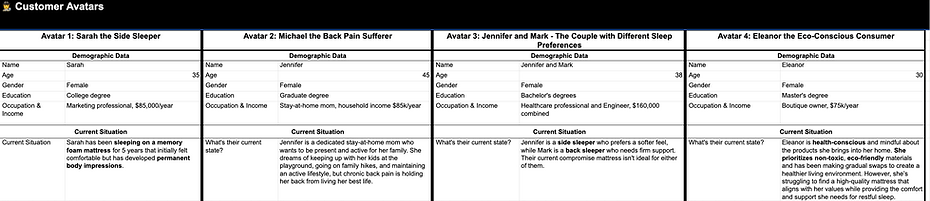
We identified 4 core customer avatars:
-
People with back pain
-
Couples with different sleep preferences
-
Health-conscious people
-
Side-sleepers who wake up with hip and shoulder pain every day
Each persona got its own content strategy.
ANGLE DIVERSITY:
Take just the back pain persona. We didn't stop there.
We analyzed close to 4000 customer reviews, on top of every Reddit thread and Facebook ad comment we saw and discovered back pain customers actually break into 4 distinct sub-groups:
-
mattress-attributed pain - we blamed their current mattress
-
work-related back pain - we connected sleep quality to work performance
-
injury/accident-related pain - we focused on recovery and proper spine support
-
chronic medical conditions - we emphasized long-term health management
Every one of those groups needed a different angle and a different message in order to have a better chance at converting them.
FORMAT DIVERSITY:
Then we deployed different formats for each awareness stage within that persona:
-
VSLs & Podcast-style ads for Unaware audiences - deep education about mattress toxins and back pain connection
3000+ Likes

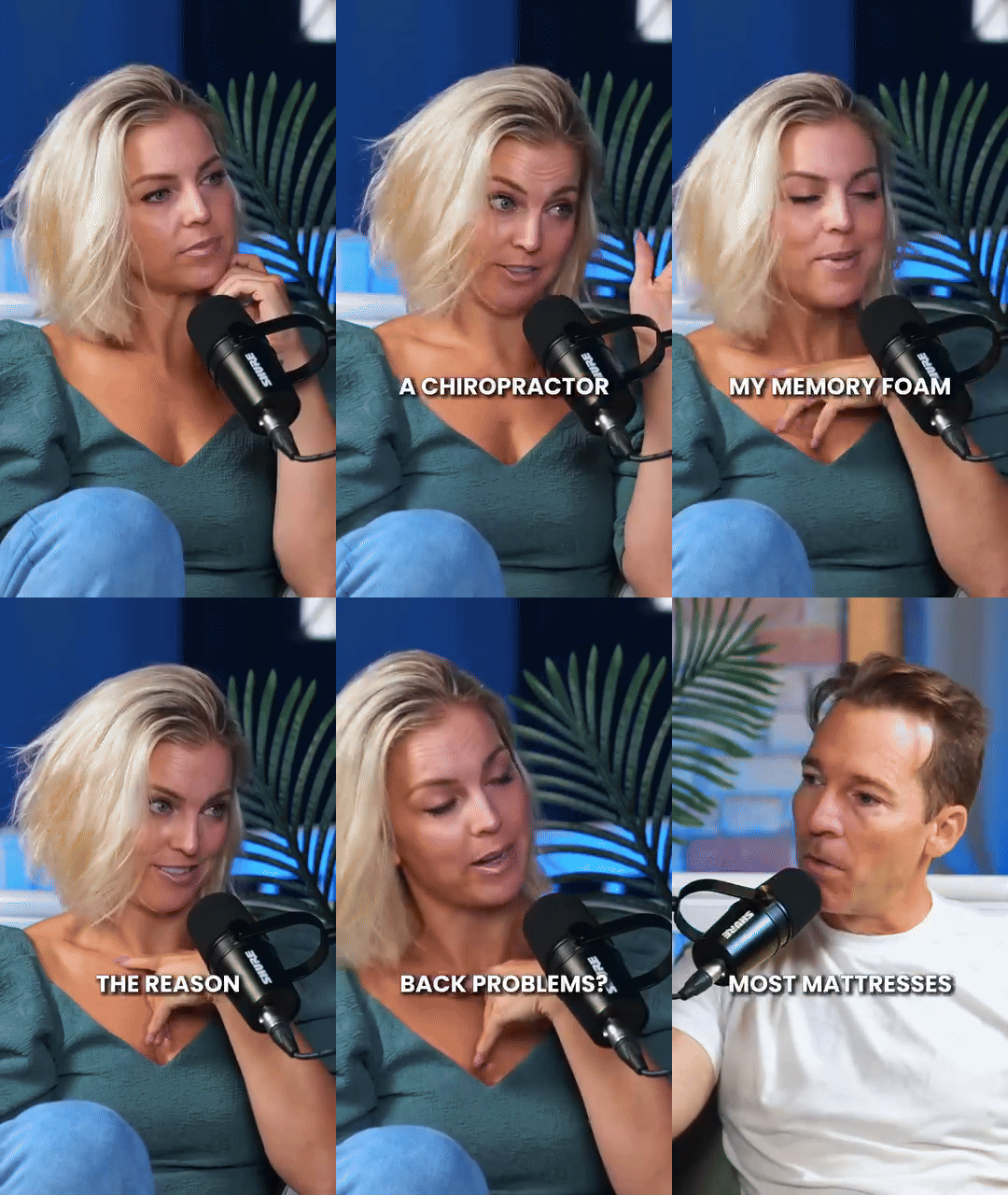

3600+ Likes

-
UGC & VSLs for Problem Aware - conversational content connecting their symptoms to their mattress


-
Static Ads for Solution Aware - social proof handling objections in real-time
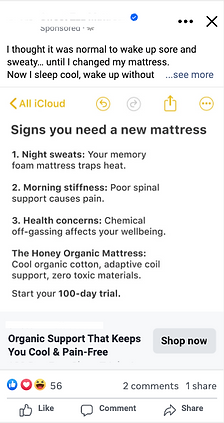


Same persona, same core angle but multiple formats unlocking different segments at different awareness stages.
The result was not 1, not 2, not 3, but 12 different ads generating more than $100k in revenue and 2 generating more than $200k in sales.

I don’t know if you can call this luck, but it felt like a smooth operation aligned with everything that the client told us about who their customer is, and it worked.
The next logical question is:
"Okay, this worked for 1 company. But does this work for MY industry?"
We’ve been working on developing and perfecting this system for 3 years now, and it has worked across multiple different categories.
Of course, such case studies do not come up every day, but we have a few notable mentions in the last 18 months.
Mattresses (2025): $100k to $1M per month in 11 months

Beauty accessories (2025): 8-figure brand - our first ad became their top-performing creative in the entire account, generating close to $500k in sales.

You see the LJV label in front of the top-spending ad.
Supplement DTC brand (2025): Helped them 5x their ad spend and scale to $1.5M/month.

Digital Book Publisher (2024): $0 to $2.5M in 12 months.

Pet food (2024): $200k to $420k per month in 7 months

Lightsabers (2023): Scaled to $600k per month in 6 months, after them seeing a massive drop in sales for 3-4 months straight.

Weighted blankets: Cracked the TikTok algorithm, scaled to $500k per month
And a lot more smaller wins scaling brands past $100k - $200k/mo in revenue that I have no data to even back those claims up because one way or another we stopped working with those smaller accounts.
Multiple different industries.
Multiple different products.
Multiple different price points.
Same framework. Same results.
Your industry isn't special.
Human psychology is.
Understanding awareness stages works for mattresses and lightsabers.
Persona diversity works for pet food and beauty products.
Format diversity works across every category.
So if you're sitting there thinking "this won't work for my niche"... that's exactly what every one of these brands thought before they started with us.
Here’s a recap:
The problem is that most brands are targeting 3% to 20% of their audience while missing the 80%.
The solution is the Larger Market Formula + UGC 2.0 Framework mapped to awareness stages.
In case you want to work with us, our creative packages start at $10,500 per month with a 3-month minimum commitment because you can’t create a strategy for a 30-day period.
If interested, click the link below and book a 30-minute strategy session with us.
We'll analyze your current approach, identify what you're missing, and show you exactly how this would work for your brand.
